


In this latest post in the series The Future of Money, I look at how CBDCs could change real estate investing.
I, along with many people of my generation, am completely opposed to the introduction of a Central Bank Digital Currency, for reasons which I will lay out in a later post. However, we still need to educate ourselves about what they are, how they will affect us and how we can prepare for them if they do come.
So here I set out six ways in which they might specifically affect property and real estate investors.
1. Faster and More Transparent Transactions
Buying a home or an investment property is a stressful experience in the England, where I have my property portfolio. Once your offer is accepted and you appoint your conveyancer, it is a waiting game. You may have crystallised your deposit funds, which will be sitting idly in a low interest savings account and you are paying money for searches and surveys to be done.
At any point during the purchasing process (which could take 15-20 weeks), a vendor may pull out, you might get gazumped or you may find something that makes you want to pull out.
So, you have months of stress, until you finally reach completion date. Now you have to transfer a considerable sum of money to your solicitor to pay the deposit. This sum of money might be 25% of the value of the property, it is certainly the most money I ever send via bank transfer. Will the money arrive in time and have I sent it to the correct bank account? It’s just an unpleasant and stressful time; however, it is worth it once you get the tenant in your property and start receiving rental income.
My hope is that if CBDCs come they will at least alleviate this stress:
Instant settlement
There should be no more waiting days for bank transfers to happen or solicitor hold-ups. Your funds should move in real time.
Smart contracts
Smart contracts could automate the completion process. For instance, funds will only be released when certain conditions are met e.g. title has cleared or the survey has passed. Programmable CBDC payments could streamline buy-to-let purchases or offer deposit protection. I looked at programmable payments in my previous post What is CBDC and why it matters to everyday investors.
Less reliance on intermediaries
This should potentially provide cost savings and make deals much simpler.
2. More Visibility & Taxation
More visibility and taxation is definitely a tick in the box on the Government’s side of the ledger. At best it will be neutral for us entrepreneurs and probably negative.
Every CBDC transaction will be recorded, so there will be no more “under the table” deals.
HMRC or your country’s tax authorities might be able to automatically see when you buy/sell, and how much you paid. They should then be able to calculate and charge you Stamp Duty or Capital Gains Tax (CGT) in real time if you are selling.
If you have nothing to hide, why should you worry? I hear this refrain a lot these days. All I would say that it is a matter of personal privacy. I also have nothing to hide, but I still close the blinds when I’m getting undressed!
As a practical step, make sure all your property transactions and tax planning are watertight and compliant. There will be no more grey areas.
3. Lending & Mortgages Might Shift
Specifically, around money and real estate, CBDC-based mortgages could be approved, funded and repaid in real time using programmable smart contracts.
There might also be opportunities around fractional ownership. Shared equity schemes might be tokenised and paid through CBDCs. This will present opportunities for smaller investors, who will be able to gain the benefits of property returns, without risking large chunks of their capital.
There could also be peer-to-peer or decentralised lending, using CBDCs as stable collateral.
Keep an eye on fintech lenders who may start offering CBDC-native mortgage products. These will be especially useful for creative deals or JV finance.
4. Cash Will Lose Relevance
We have already seen the use of physical cash plummet, post 2020. This trend will increase with CBDCs. Those who traditionally used physical cash (e.g. private landlords or certain overseas investors) may lose flexibility or anonymity.
Rental payments, deposits and agent fees will all be digitally recorded. It will be harder to hide income or delay reporting.
As with point 2. above, start to position yourself as a “compliant and modern landlord,” so that you are ready to work with digital systems and transparent processes.
5. Cross-Border Investment Gets Easier
As CBDCs may be interoperable globally, meaning that for instance a digital pound will be easily converted to a digital euro. Therefore, investing abroad becomes faster and cheaper. For those who wish to purchase abroad or foreign investors buying UK property, this will be a lot easier.
Currency conversion could be instant, and foreign investment reporting could be automatic.
So, if you’re targeting international investors or plan to buy abroad, this could unlock major speed and trust advantages.
6. Privacy Trade-Offs
There will be benefits to CBDCs for real estate investors, however the big turn off for me is in the trade-off it will give in lack of privacy. Your buying patterns and asset accumulation will be more visible to regulators. I do not trust socialist governments to mind their own business. I don’t know about you, but my business is my business.
Speculative investors may also shy away from overly transparent systems. This could reduce froth in the market or shift demand to different asset classes (like private equity, gold, or crypto).
Therefore, you should build a long-term investing strategy rooted in fundamentals, not short-term plays that rely on opacity.
Strategic Opportunities for Property Investors
My philosophy has always been to hope for the best but to prepare for the worst. Certainly, with CBDCs I would rather that we didn’t have them, but I am realistic enough to realise that in all likelihood they are coming. I am therefore preparing for them and also looking at potential opportunities. Here are some preparation steps and opportunities that you may want to explore if you are of a similar mind:
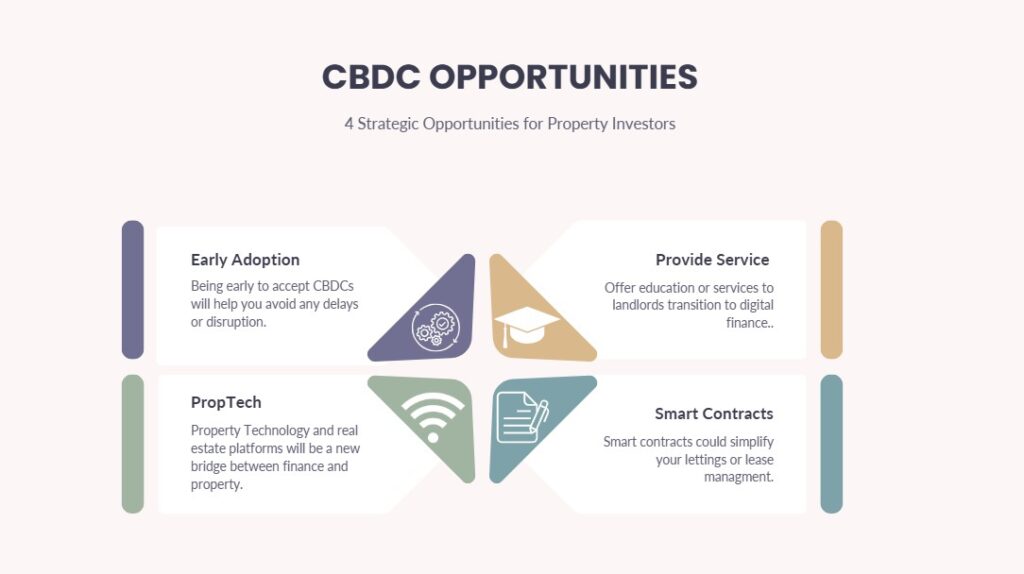
Early adoption: Be early in accepting CBDC payments for rent, deposits or services. This will help you to avoid any delays and disruption when they are universal.
Provide services: You could begin to investigate offering education or services to landlords transitioning to digital property finance.
Proptech: Get involved in property technology or CBDC real estate platforms. These will be the new bridge between property and finance.
Smart contracts: Consider how smart contracts could simplify your lettings or lease management.
Stay informed: Track CBDC implementation timelines so you can buy or sell at ideal transition moments. Some buyers may be frozen out if unprepared. Check out your country’s central bank and government finance department’s CBDC updates.
Summary
CBDCs will make the property market:
- More transparent
- More digital
- More regulated
- More efficient
If you are already in the game, when they arrive and are willing to embrace tech, compliance and speed, you will thrive. If not, others will swoop in with fintech models and eat your lunch.
Found this thought provoking? Join my community newsletter to make sure you get up to date information I put out.