
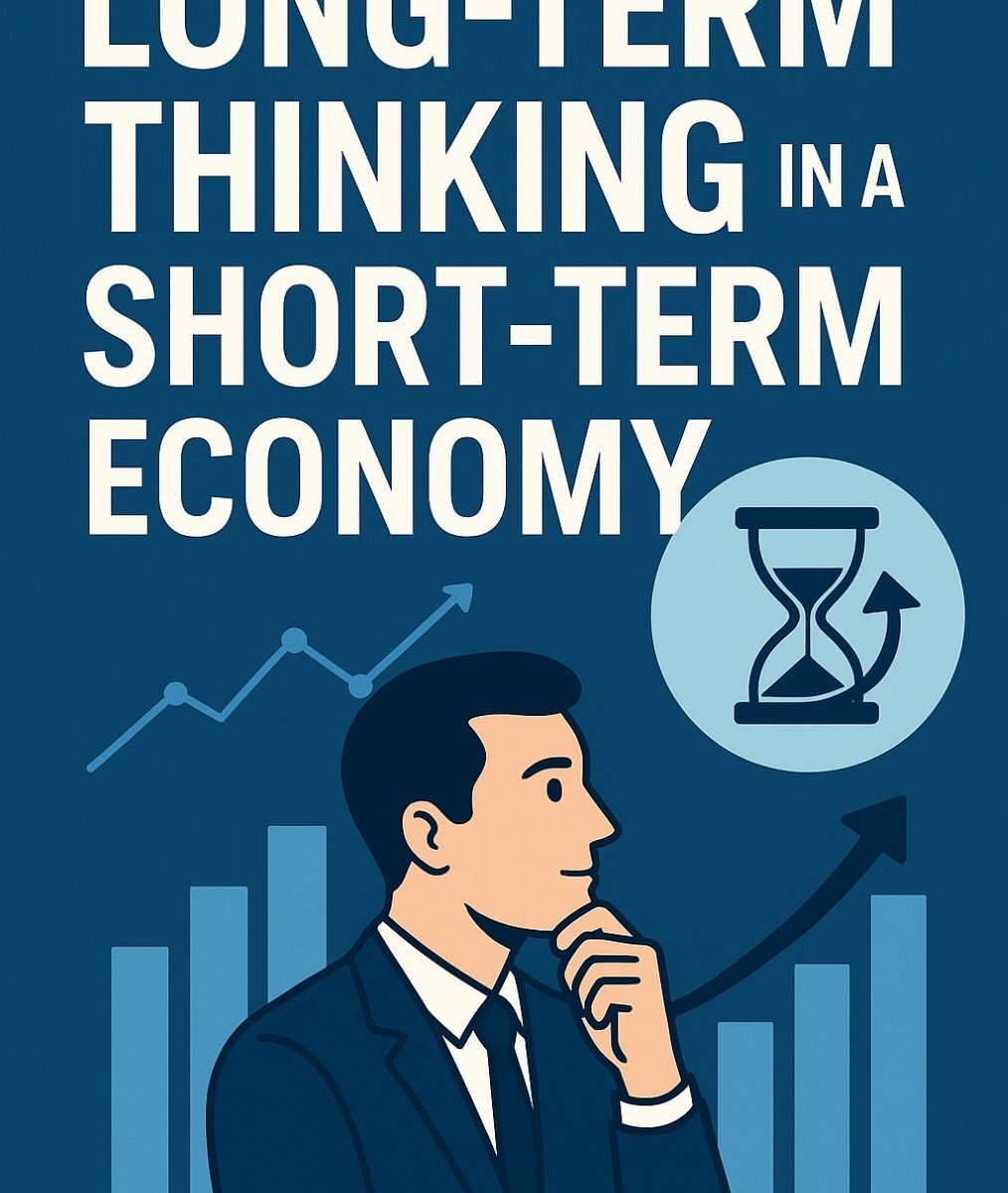
We’re living in an age where everything seems to demand instant action. Markets swing wildly. Politicians chase headlines instead of stability. Businesses optimise for quarterly earnings rather than decade-long legacies. Even our phones train us to crave dopamine hits in seconds, not months. It’s no wonder that most people—without even realising it—start making their financial decisions in the same reactive, short-term way. In this post I’m espousing long-term thinking as an alternative.
This short-environment creates a unique opportunity for anyone willing to zoom out. Long-term thinking becomes a competitive advantage. Not a vague philosophy, but a practical strategy for building wealth, confidence, and resilience in a world that constantly pushes you toward panic mode.
If the wider economy is short-term, then long-term thinkers become the outliers who win.
In this post, we’ll look at why long-term thinking matters more today than ever, what gets in the way of it, and how to put it into action—especially if you’re building wealth through property, content, business, or any modern income stream.
The Short-Term Trap
Modern economies tend to reward fast feedback loops: quick profits, quick metrics, quick reactions. But what looks like progress can easily become noise. Industries inflate bubbles by chasing the next big thing, not the next big decade. Investors chase hype cycles. Savers jump ship at the first sign of volatility. And governments often firefight instead of plan.
There are three major traps that pull people into short-term thinking:
1. Information Overload
We’ve never had more access to data—but most of it isn’t meaningful. Market updates ping every second. Social media feeds show curated success stories that make everyone feel behind. This creates urgency that isn’t actually real. You see someone announce they “made five figures this week,” and suddenly your decade-long plan feels too slow. But that’s emotion, not strategy.
2. Economic Instability
Inflation, interest rates, geopolitical shocks—each cycle fuels uncertainty. Uncertainty pushes people into short-term survival mode. You start questioning whether you should stick with your plan… or switch to something faster. When everything feels shaky, acting quickly feels safe, even if it’s not.
3. Impatience Disguised as Ambition
The modern economy celebrates hustle, but hustle has a downside: it rewards speed more than endurance. You see this with fad investments, “next big thing” wealth plays, and business trends that burn out as fast as they appear. Ambition is good. But ambition without strategy becomes chaos.
This is where long-term thinkers stand out. While everyone else reacts to every blip on the screen, long-term thinkers operate from principles—not panic.
The Long-Term Advantage
Long-term thinking doesn’t mean sitting back passively. It means making decisions that compound, rather than decisions that merely stimulate. The long-term economy isn’t slow—it’s strategic.
If you look at the people who build real wealth, real freedom, and real legacy, they share a handful of traits:
1. They Focus on Compounding
This applies far beyond money. Skills compound. Content compounds. Credibility compounds. Property equity compounds. Relationships compound.
Short-term players tend to underestimate how much can happen over five years of consistent, strategic action. They want what works instantly, but that’s rarely what endures.
2. They Navigate Volatility, Not Fear It
In a jittery economy, volatility is the price of long-term opportunity. Long-term thinkers understand that cycles are normal. They prepare for them instead of being blindsided by them. They see downturns as buying opportunities—whether that’s investments, talent, businesses, or skills.
3. They Build Assets, Not Distractions
Short-term thinkers chase trends.
Long-term thinkers build systems.
Property—one solid rental over ten years beats ten rushed deals.
Business—one evergreen product beats ten gimmicks.
Content—one sharp idea published weekly for a year beats twenty abandoned experiments.
4. They Optimise for Freedom, Not Frenzy
Anyone can grind.
Few people can build something that outlasts their grind.
Long-term thinkers design their work, wealth, and habits to create margin. They prioritise sustainability and build room for creativity, health, learning, and relationships. They know the goal isn’t to “do more.” It’s to create leverage.
This mindset shift doesn’t just change how you plan. It changes how you feel. Decisions become calmer. Progress becomes clearer. Setbacks become easier to absorb.
Why Long-Term Thinking Matters More Than Ever
Paradoxically, the faster the world becomes, the more valuable long-term thinking is. Here’s why:
1. High Speed Creates High Noise
When everything moves fast, everybody reacts emotionally. That means mispricing—of assets, businesses, opportunities, even personal time. The person who stays rational gains a built-in edge.
2. Technology Has Shortened Attention Spans
Which means consistency becomes rare. When you show up with long-term discipline, you instantly stand out. Most people sprint. Long-term thinkers win the marathon—simply because very few people finish it.
3. Global Shifts Are Inevitable
AI, decentralised systems, CBDCs, demographic change, economic power shifts—these aren’t weekend news stories; they’re decade-long arcs. Those who plan for the arc instead of the headline thrive.
If you haven’t heard of CBDCs then I suggest reading my post What is a CBDC and why it matters to everyday investors. In that post I explain what they are and why they are coming.
4. Wealth Is Becoming More Skill-Based
Property still works. Business still works. Investing still works. But everything benefits massively when paired with skills that compound: writing, digital leverage, financial literacy, audience building, analysis, negotiation. Long-term thinking is what helps you pick which skills to sharpen and commit to.
Long-Term Thinking in Practice
Theory is easy. Execution is where most people fall off. Here are four simple, practical ways to implement long-term thinking—without losing momentum.
1. Build a 10-Year Vision, But a 90-Day Plan
Long-term direction.
Short-term execution.
This removes overwhelm and keeps your actions grounded. Every 90 days, ask:
- What would move the needle if I repeated it for 10 years?
- What deserves my time?
- What can I eliminate because it doesn’t compound?
The more you repeat this, the clearer everything becomes.
2. Choose Assets That Compound, Not Activities That Drain
Ask yourself regularly:
Does this scale, compound or still matter in five years?
If the answer is yes, it’s long-term aligned.
3. Master Boring Consistency
The long-term game is built on repetitive, unsexy moves that most people give up on:
- Weekly posts
- Monthly investment contributions
- Quarterly reviews
- Yearly skill-building
- Daily health habits
Consistency creates momentum—and momentum creates inevitability.
4. Expect Setbacks Instead of Being Shocked by Them
Short-term thinkers collapse at the first setback.
Long-term thinkers treat setbacks like data.
Missed a goal? Adjust.
Had a flat month? Recalibrate.
Market shifted? Adapt faster.
Resilience becomes a practical skill, not an emotional reaction.
The Payoff: Why This Mindset Wins
The real payoff from long-term thinking isn’t just money. It’s clarity. Confidence. The feeling of being grounded while everyone else feels frantic.
You become the person who:
- Makes better decisions under pressure
- Sees opportunities earlier
- Stays stable when others wobble
- Accumulates assets that snowball
- Builds a brand, not just noise
- Earns from work done years ago
The short-term economy pushes people into panic, distraction, and exhaustion. Long-term thinkers become the ones who build something that lasts—financially, creatively, and personally.
And as the world continues to speed up, your calm, strategic approach becomes even more valuable.
In a short-term world, long-term thinking isn’t just wise—it’s a superpower.
In the next post I will move gears from self-help to how you can help others in this new economy. Sign up for the newsletter so you don’t miss out.