

In the previous post in this series of the future of wealth I discussed ways in which you can protect your wealth in the coming Central Bank Digital Currency CBDC era. One of the ways we looked at was moving any surplus CBDC money as soon as possible into appreciating or income producing assets as soon as possible. Alternatively, you could convert this money into a form that at least holds its value relative to inflation over time. Therefore where should you store your wealth in the CBDC era?
This week I give you an overview of the types of assets you could convert your hard earned CBDCs and regular cash into, so that they provide income, or at least hold their value or hopefully increase. As with all my posts on financial matters, I am not a financial adviser and you should take advice from an IFA before making any investments. However, with the information in this and other posts, you will at least be able to have an educated conversation with your advisor.
Assumption
I will assume that you have in place the standard commonly advised methods of wealth protection. If not then please see my post on wealth protection where I describe the various vehicles you should have in place to protect your wealth including Insurance, Life Assurance and Wills etc. I also include in this the company pension scheme if you have one available.
Once you have the basics in place you can start to divert your surplus cash (future CBDCs) into the assets. Here is an overview breakdown of the types of assets that are available.
1. Stocks and stock funds
Stocks are shares of individual companies, which offer the potential for high growth, as you become a part-owner of the business. These can be divided down further:
Growth stocks
Growth stocks are companies which are expected to grow faster than the overall market, such as (at the time of writing) some technology companies. These stocks often reinvest their profits back into the business rather than paying dividends. Your hope is to park your money here and let it grow.
Dividend stocks
Companies that pay out a portion of their profits to shareholders are termed dividend stocks. They can provide a steady income stream in addition to potential stock appreciation.
Value stocks
Stocks that are believed to be undervalued by the market. The goal is to hold them as their price eventually increases to reflect their true value. This strategy has a higher risk as you are trying to time the market and you need technical and analytical skills to determine if they are undervalued.
Stock funds (Mutual Funds, ETFs)
I do not buy individual stocks – either growth, dividend or value. For me, the strategy is too risky. A far less risky strategy is to invest in a fund that holds a collection of stocks, which provides instant diversification. Mutual funds are usually managed. This means that someone chooses the stocks to go in the fund you have chosen. This means that fees can be higher.
Index funds
My preferred method of investing in the stock market is through Index Funds. These are types of mutual funds that track a specific market index, like the S&P 500 or FTSE 100. This gives you the broad market exposure, but as the stock picking is automatic, the fees are much lower.
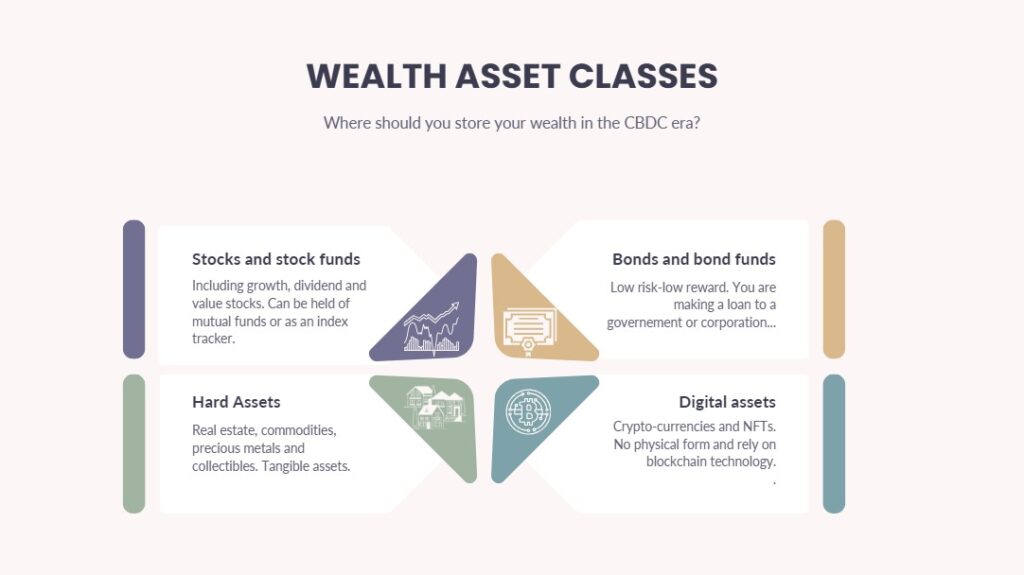
2. Bonds and bond funds
Bonds are a loan you make to a government or corporation, which pays you fixed interest over a fixed period. At maturity you then receive back your principal. They are considered lower risk than stocks, but again skill is needed when timing the markets.
Bond funds are a collection of bonds from various issuers, which reduces the risk of any single company defaulting.
A word on Pensions
Defined contribution pension schemes, which are most common now, invest on your behalf into a range of assets, such as stock funds, bond funds, cash and index trackers. Most people don’t realise that you can choose what proportion of your pension contributions go into which types of vehicle. Instead, they go with the default proportion. This may or may not be the best for you. Speak to your financial adviser or the pension fund manager to tailor it to your preferences.
3. Hard assets
Hard assets as the name suggests are physical and tangible assets, which will have intrinsic value. This value may appreciate over time over the long term, which would be your motive for investing in them. In the short term, volatility in their prices may also present opportunities for trading profits. However, our goal is to store our wealth over the long term, in something tangible. Examples of hard assets are:
Real estate
I invest in real estate and this has been good for my finances. However, I do realise that it isn’t for everyone. If you are interested in exploring this as an option then I would recommend reading my Start Here page, where I walk you through the first steps when considering whether to invest in property.
Rental properties
Rental properties, if set up correctly will generate a steady income from rent and appreciate over time.
Real Estate Investment Trusts (REITs)
Not strictly a hard asset, REITs are a way to invest in real estate through funds that own and operate income-producing properties. This is a way to invest in property without the hassle of owning individual properties.
Land
Increasingly land is becoming a favoured investment for wealth holding. As land and resources become scarcer, the value of land will appreciate.
Commercial property
Income and capital gains can also be had from owning commercial property, such as office space, retail and industrial units. The tax implications will be different from domestic property, so you would need advice from a tax advisor.
Commodities and precious metals
Commodities
Oil, gas and agricultural products are commodities, which have utility and therefore value. There prices can be volatile and some commodities are perishable, meaning that you would really need to know what you are doing.
Precious metals
Gold and silver are the obvious choices when investing in precious metals. I will be writing more about these in a future post. Over time they will hold their value, so they are often an good hedge against inflation. Other precious metals such as platinum and palladium can also be invested in.
Collectibles
Anything you can collect, can be a good store of wealth. Examples are myriad, but here are a few: Art, wine, whiskey, coins, stamps, antiques, books. You get the picture. Only invest in something you are genuinely interested in and/or are prepared to become an expert in.
4. Digital assets
I find that the older I get the more I am pushing back against the digitisation of everything. This is manifesting in things like moving to a physical notepad. I still store files digitally although I keep copies on a hard drive, rather than solely in the cloud. But what about things like your wealth?
In finance, digital assets are any electronic item of value that can be stored, transferred, and traded digitally, most often on a blockchain or similar technology. This includes a wide range of assets, from cryptocurrencies like Bitcoin to non-fungible tokens (NFTs) and tokenised real-world assets, such as a digital representation of a house deed.
Key characteristics of digital assets
Digital assets as the name suggests have no physical form and exist purely in a digital format. They rely on blockchain technology to keep them secure, transparent and decentralised.
Why would you consider investing in digital assets? Well, they can give value in a range of ways, for instance as a currency, a claim on a physical asset or ownership rights.
Examples of digital assets
Cryptocurrencies
Decentralised digital currencies like Bitcoin and Ether. I will be writing a lot more about these in a later post. Sign up to the newsletter so you don’t miss this.
Stablecoins
These are a type of cryptocurrency, but they are pegged to the value of a stable asset, like a fiat currency used to do.
Non-fungible tokens (NFTs)
Unique digital assets that can represent ownership of a one-of-a-kind item. Non-fungible means they can’t be divided or substituted. Money and cryptocurrencies are fungible as they can be divided into smaller fractions. It is beyond the scope of this post to go into all the possible examples of NFTs but as an idea you can buy NFTs of digital content such as digital art, photographs or domain names. Your ownership of the asset will be recorded in a blockchain.
Tokenized assets
Similar to NFTs, tokenised assets are digital representations of the asset itself. This could be traditional assets like real estate, commodities or art. Here you could for instance own a fraction of the original asset like a real estate property or even civil infrastructure like a bridge or a road. Again, the examples are only limited by human imagination.
Central bank digital currencies (CBDCs)
A digital form of a country’s fiat currency, which we are trying to diversify out of. See my post What is a CBDC and why it matters to everyday investors for more on this.
Criteria for choosing which asset class
So, there you have my whistle-stop tour of the assets you can diversify in, to remove your wealth from CBDCs. The next question is what should you invest in?
I can’t answer that for you as everyone is different and you shouldn’t blindly follow what people online suggest. The first step would be to discuss your situation, with an Independent Financial Advisor. Ask them if they are a whole-of-market advisor, so they are not just plugging certain products for commission. Ideally you want to be paying them for their advice, so that it is impartial. Here are some criteria that will determine what you should invest in:
Asset allocation
A financial advisor will recommend an asset allocation in a certain proportion depending on your unique situation. This means that you might allocate your wealth into several different asset classes to give an overall risk-reward profile. What that profile is will depend on the following:
Age
What age you are now will determine what level of risk you are likely to be able to withstand. The younger you are the more time you have to recover from market downturns. You can therefore invest in higher risk higher reward vehicles, such as stocks. As you approach retirement age, you may wish to divert your wealth into less risky but lower return assets, such as precious metals, bonds or cash.
Circumstances
Your unique set of circumstances will colour how you should set up your asset allocation.
Work status
Are you currently working? If you are you may be in a growth season of life. Your IFA will therefore recommend growth assets. If you are approaching retirement or are retired your mindset might be to invest in income generating assets, with a hedge against inflation.
Debts/mortgage
How much debt you are currently burdened with, should determine whether you set a plan to pay this off. With repayment mortgages, they may be left to run their course. However, if your property is in negative equity or if you have an interest-only mortgage, then paying some of this off first may be a course of action.
Dependents
Bringing up children and having dependents might mean that you forego investing in longer term illiquid assets as you will need a safety net of ready funds to ensure you withstand any unexpected bills. As the children leave the nest, you will be freer to invest in other assets.
Insured
A good IFA should ask you what your level of insurance is. Is it currently enough for your current circumstances? You might need to divert funds into, for example, life assurance, mortgage protection or critical illness cover.
What is it for?
What do you want your wealth to do? That sounds a silly question and the answer will flow from the circumstances above, your inclination and risk attitude. Do you want your wealth to grow in real terms for the future? Do you want it to provide income now? Or do you want to store your wealth somewhere where it won’t be depreciated by inflation? You might want a combination of these answers, in which case your IFA should be able to recommend a suitable asset allocation.
Do you have knowledge or a specialist interest in any asset class?
As Warren Buffet says, don’t invest in anything you don’t understand. On the other hand, are there any asset classes that you have prior knowledge or experience in? Are there any that you are currently interested in that you could devote some time in gaining an deeper understanding? If there is then this might be a good area to invest in. Dip your toes in the water first, with smaller investments. Treat it as a education. Only invest what you can afford to lose.
Summary
As we move into the CBDC era, knowing where to store your wealth becomes just as important as how much of it you have. In this post, I’ve outlined the main asset classes, from stocks and bonds to property, precious metals and emerging digital assets. You can now start thinking strategically about how to protect, grow and future-proof what you’ve built.
The right mix depends on your goals, risk tolerance and stage of life. One thing is certain: diversification is your best defence in an uncertain financial world. Now’s the time to get clear on your next move. Subscribe to my newsletter for the next post in The Future of Wealth series, where I’ll break down how to build your personal wealth strategy, step by step and in plain English.