

In this latest post on the future of wealth, we delve into the world of Decentralised Finance Protocol (DeFi). We will also explore how you can start to use it. With that in mind we look at your first £1,000 in a Decentralised Finance Protocol.
The Difference Between DeFi and Cryptocurrency.
Although a cryptocurrency is not a type of DeFi, it is a core component that DeFi is built upon. DeFi uses cryptocurrencies and blockchain technology to create a decentralised financial system for services like lending and trading, while traditional cryptocurrencies mainly serve as a medium of exchange or a store of value.
Cryptocurrency
Crypto is a digital or virtual currency that uses cryptography for security and operates on a decentralised ledger, or blockchain. Check out my post Crypto for Beginners: How to Use Cryptocurrency for Wealth Protection, Not Speculation. In that post I talk about Crypto’s key features and how you can safely invest in it.
Decentralised Finance (DeFi)
DeFi is a broader ecosystem built on blockchain technology that uses cryptocurrencies to provide a range of financial services, such as lending, borrowing and trading, without traditional intermediaries like banks.
In essence, you use cryptocurrencies to access and engage with DeFi applications.
What Exactly is DeFi?
Decentralised finance (DeFi) is an emerging financial system that uses blockchain and smart contracts to enable peer-to-peer financial transactions without intermediaries like banks. DeFi applications replicate traditional financial services such as lending, borrowing and trading, but operate on a distributed ledger technology.
How DeFi works
DeFi services are built on public blockchains, which are distributed digital ledgers.
These services use “smart contracts,” which are self-executing pieces of code that automatically execute transactions when certain conditions are met.
Unlike traditional finance, DeFi aims to eliminate the need for centralised authorities like banks or brokerages to facilitate transactions.
The Benefits of DeFi
So why as a writer on personal finance and retiring early, am I researching and writing about DeFi? Well, the benefits of DeFi will answer that question. If you’ve read my earlier posts in this series on the future of money, you will know that I believe Central Bank Digital Currencies (CBDCs) will be implemented and what this means for our privacy and freedoms. DeFi is one strand of your strategy to mitigate against that.
Transparency
All transactions are recorded on a public blockchain, providing transparency.
Accessibility
Anyone with an internet connection can potentially access financial services, as it removes the need for traditional bank accounts.
Lower costs
By removing intermediaries, DeFi can potentially lower transaction fees.
Speed
Transactions can be settled very quickly, sometimes in seconds or minutes.
The Risks of DeFi
As with anything there is always a downside to every upside, so here are the risks associated with DeFi:
No regulation
The lack of a central authority means DeFi services are largely unregulated and do not have the consumer protections of traditional finance, like The Financial Services Compensation Scheme (FSCS) in the UK or FDIC insurance in the US.
Security
Despite the blockchain’s security, the smart contracts and software systems are vulnerable to hacks and scams, leading to significant financial losses.
Complexity
The technology can be complex and difficult for the average user to understand, increasing the risk of mistakes or falling for scams.
No recourse
Unlike traditional finance, there is often no way to recover lost funds if a hack or scam occurs.
Volatility
DeFi investments are often considered speculative, and users are advised not to invest more than they can afford to lose.
Investing Safely in a DeFi
To invest safely in a Decentralised Finance (DeFi) protocol, with say £1,000, your primary strategy should be to minimise risk through diversification and using proven, audited protocols. Lending stablecoins on established platforms like Aave or Compound is a conservative approach to earn passive income with less exposure to crypto market volatility.
For enhanced security, you must use a non-custodial hardware wallet and only invest an amount you can afford to lose.
How to invest in a DeFi
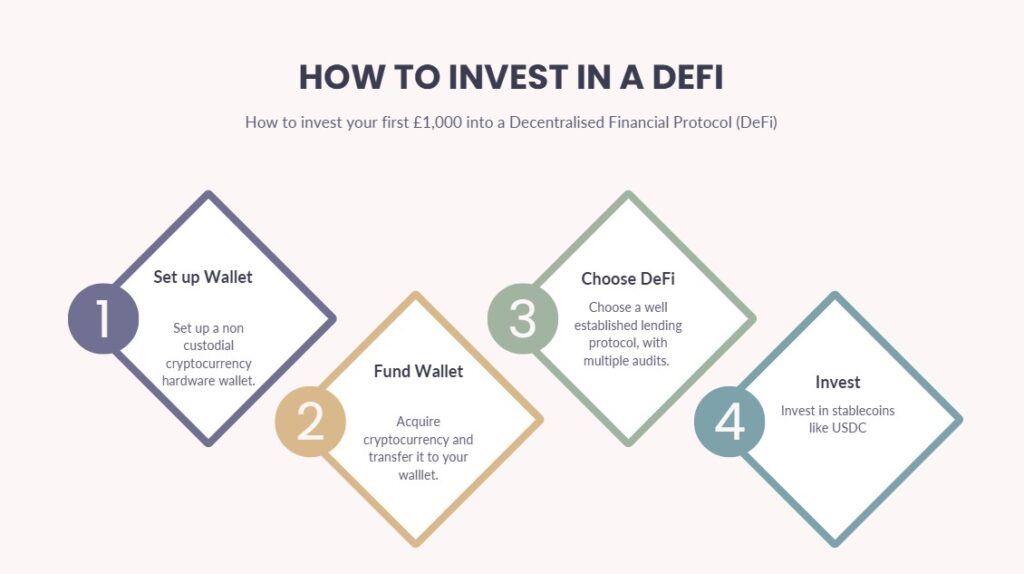
Here are the steps for you to safely invest your £1,000 in a DeFi:
Disclaimer:
Just because I’m financially independent doesn’t mean you can sue me if you blow your savings on crypto llamas. This blog is for education and entertainment—not financial advice. Before making any money moves, speak to a qualified (and hopefully not-broke) Independent Financial Advisor. You know, the kind with certificates and a filing cabinet.
Step 1: Set up a secure wallet
You will need a non-custodial crypto wallet to interact with DeFi protocols directly, as they are not reliant on centralised entities.
For enhanced security, especially with significant amounts like £1,000, a hardware wallet like Ledger or Trezor is recommended, as it stores your private keys offline.
For ease of use, you can start with a software wallet like MetaMask, which is compatible with most decentralised applications (dApps). Always write down your seed phrase and store it securely offline.
Step 2: Fund your wallet with cryptocurrency
To start your DeFi journey, you need to acquire some crypto and transfer it to your non-custodial wallet.
Use a reputable centralised exchange (CEX) like Coinbase or Kraken to convert your £1,000 into a stablecoin like USDC or a major cryptocurrency like Ethereum (ETH).
Transfer your funds to your non-custodial wallet. To minimise Ethereum – Mainnet transaction fees (gas fees), consider using Layer 2 networks like Arbitrum or Optimism through a bridging tool.
Step 3: Choose a proven DeFi protocol
For beginners, it is safest to stick with well-established lending protocols that have undergone multiple security audits. Aave and Compound are leading choices.
Aave: A non-custodial lending protocol that operates on multiple blockchains (Ethereum, Polygon, Avalanche). You can deposit assets to earn interest or borrow against them.
Compound Finance: One of the earliest DeFi lending protocols, Compound is known for its simple lending model where interest rates are algorithmically adjusted based on supply and demand.
Morpho: An open lending infrastructure that delivers optimised rates for both lenders and borrowers and is backed by multiple security audits and a bug bounty program.
JustLend: A solid option on the TRON blockchain known for its low fees.
Step 4: Invest in stablecoins for a low-risk strategy
Stablecoins are cryptocurrencies pegged to a stable asset like the US dollar, making them much less volatile than other digital assets.
Deposit stablecoins, such as USDC, into a lending protocol like Aave to earn a consistent yield with minimal risk of impermanent loss.
Yields on stablecoin deposits are generally more stable and predictable than on volatile assets, with some platforms offering APYs in the range of 4–12%.
Key safety tips
Diversify
Never put your entire investment into a single platform. If one protocol fails, your other investments remain safe.
Only invest what you can afford to lose
The DeFi market is still experimental and volatile. Only invest funds that you are prepared to lose. I advocate a set asset allocation e.g. out of your net worth you could allocate 40% Real Estate, 35% Equities, 15% Cash and 10% Other. I would use the ‘Other’ allocation for your DeFi maybe no more than 1% of your total net worth.
Do your own research (DYOR)
Before using any protocol, investigate its security audits, total value locked (TVL), and community sentiment. Use tools like DeFiLlama to research projects.
Understand the risks
Be aware of potential risks like smart contract bugs, hacks and regulatory uncertainty. No protocol is entirely risk-free.
Summary
Stepping into DeFi with your first £1,000 isn’t about chasing hype. It’s about learning how tomorrow’s financial system works while keeping your risk tight and your freedom intact. By sticking to proven protocols, using stablecoins, securing your wallet and treating this as a tiny slice of your wider wealth plan, you put yourself in a position to benefit from the upside without gambling your future.
Start small, stay curious and build your competence one step at a time. The goal isn’t to get rich quick. The goal is to get prepared, stay resilient and keep your wealth working for you no matter how the system evolves.
In the next post in this series we will look into a potential future world without cash. Sign up so you don’t miss out.