

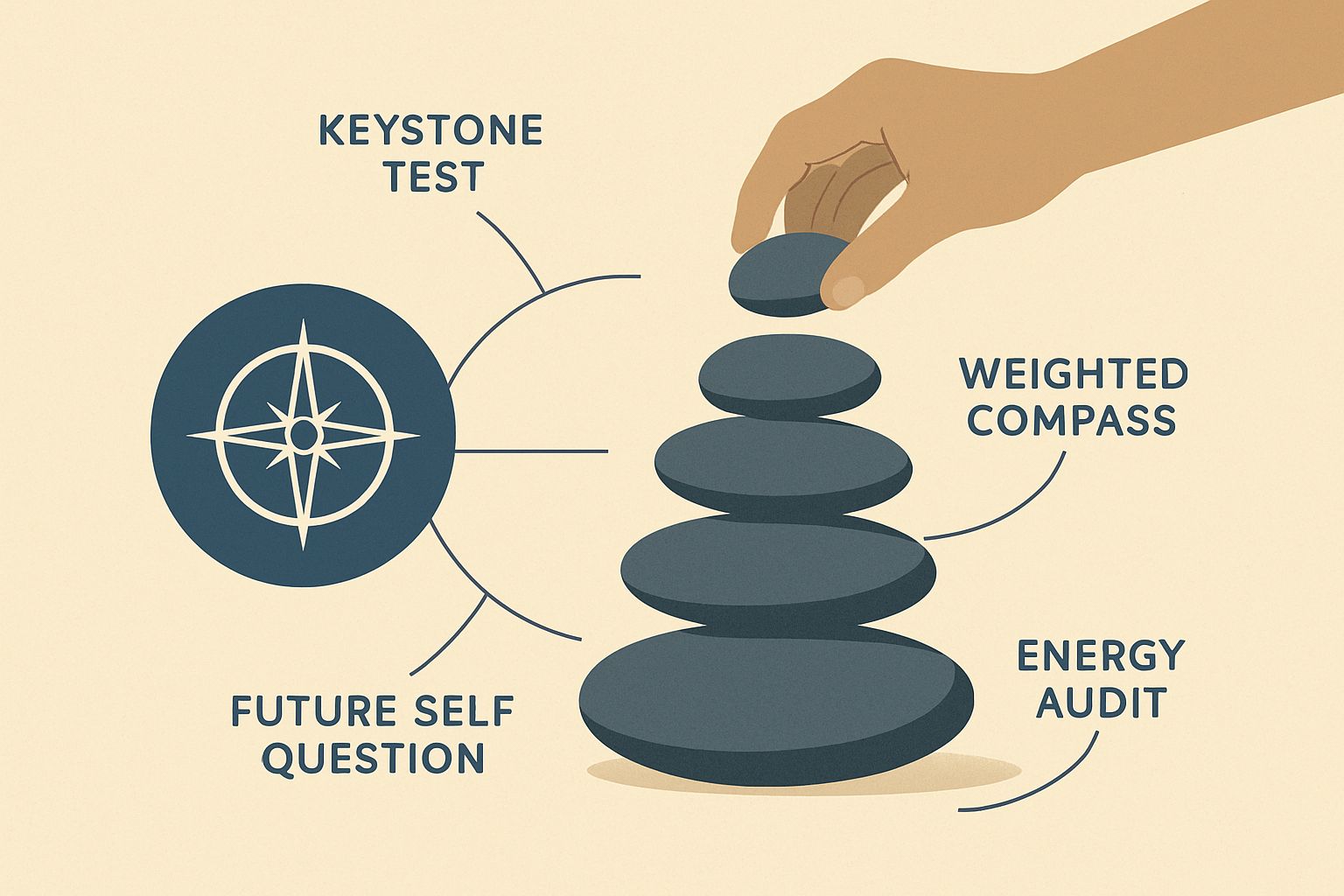
You have just completed a project or formed a new great habit. Feel the dopamine hit and enjoy the moment. But what next? Which project or habit out of the many, in your pipeline, should you plan out next? Here I give you 5 methods to choose the right next focus area.
Your first task is to enjoy the moment of completion. I do suggest that you should enjoy the process of moving to a goal or making progress, but you should make sure that you give yourself the gift of satisfaction in achieving something and finishing off.
Take your time in choosing the next area to focus on, so you can make sure that it will be the most valuable to you. When you are ready choose one of the following methods to decide your next focus area.
The tricky part is not having areas of focus, but knowing which one deserves your energy next without spreading yourself too thin or getting stuck in indecision.
1. Keystone Test
The Keystone Test finds a habit or project that will make other projects or habits easier. I.e. it might not be the most important or urgent, but more good behaviours or results will flow from it.
Ask yourself: “If I strengthen this area, does it naturally make other areas easier?”
As an example, if you choose Organisation i.e. better systems, this could often free up time and energy for what might be more major areas, such as Business.
See my post on the Keystone habit, where I show what my keystone habits are and how I plan my day to make sure I perform them. This ensures I make more impact downstream.
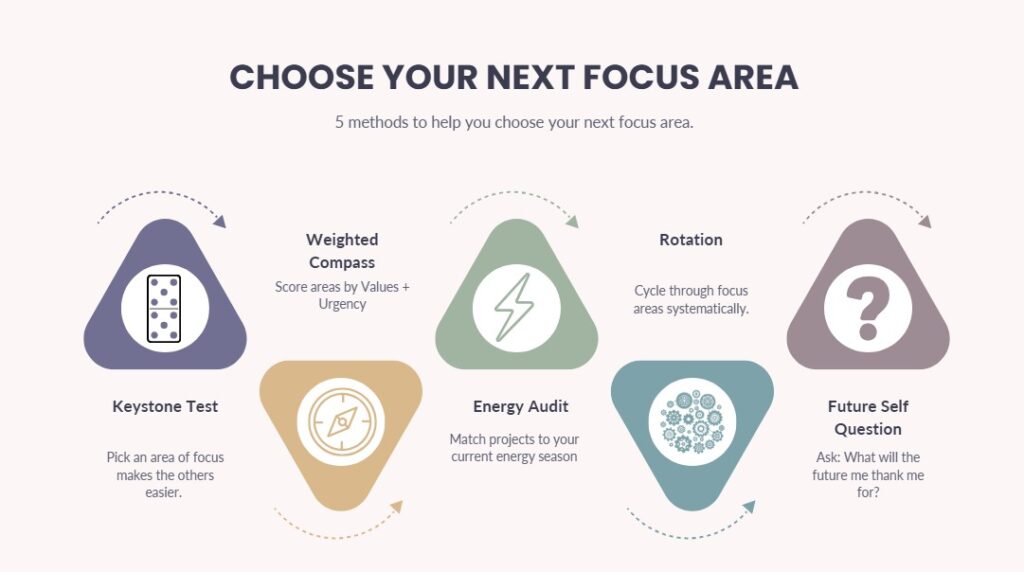
2. Weighted Compass Method (Values + Urgency)
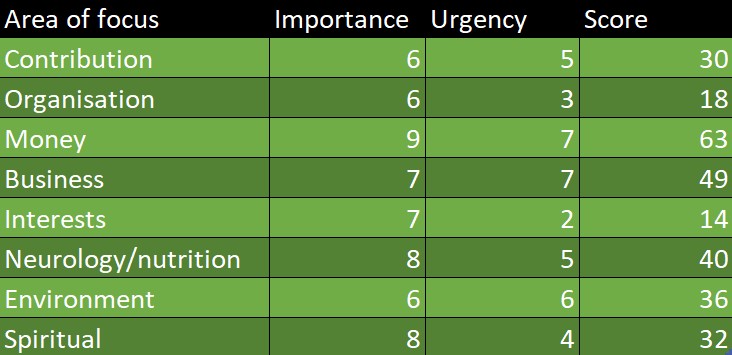
I split my areas of focus into 8 areas: Contribution, Organisation, Money, Business, Interests, Neurology/Nutrition, Environment and Spiritual. This forms the easy to remember acronym COMBINES. You may have different life areas; but whichever you use, write them down in a column list on a piece of paper with three additional columns for Importance, Urgency and overall score. (see table below). This balances heart with practicality.
Step 1: Rate each area (1–10) on two metrics:
Importance
Importance is values-driven: How aligned is this area with who you want to be long-term? At this moment in time, what is the most important area for you to focus on? You might be at the stage of life where your job/business is all important, so you would score this higher.
Urgency
Urgency is context-driven: How much immediate impact would attention in each area have in the short term? You might have neglected one area, such as your finances (Money) and sorting this issue out now would immediately improve your life. Give this a high score.
Step 2: Multiply the scores.
For each area multiply the score for Importance by the number for Urgency. This will be the overall score for that focus area. The highest combined score will be your next focus area.
In the example below we see that Money has the overall highest score. This should be the area to focus on.
3. Energy Audit
Here we are not choosing which area to focus on based on importance, urgency or impact, but whether you have enough energy to see it through. It is well known that our energy levels vary during the day due to our circadian rhythms, but what is less known is our energy can vary over longer periods.
I personally have more energy in the Autumn. This is due to months of increased sunlight and being outdoors and also with looking forward to Christmas. I can take on more energy-demanding projects because I am more energised. Often September feels like a fresh start, like going Back to School.
January and February are often grim months for me. Dark days and poor weather sap my energy. I might just focus inwards on Spirituality or my home Environment or just reading a good set of books (Interests).
Spring, for me, has more optimism with new ideas sprouting. On the downside, this can often mean I might become restless. I have a need to get cracking, after Winter, but without any clear focus. Spending time planning (Organisation) has a good impact for me then.
So, what season of life are you in now?:
Do you have high physical energy? Why not choose a big project to tackle, something in your Business or Money. Or what about Organisation. You finally have that energy to get the loft or garage tidied.
Is your energy low? Now might be the time for nurturing. Spiritual, Environment or Interests, might be rewarding.
Is your mind restless? Something calming will be the order of the day. Start a yoga practise (Neurology) or spend quality time with family and friends (Contribution).
This way you flow with yourself, not against.
4. Rotation
Instead of guessing or working out which area to focus on, simply list your areas of focus and just choose one per week. This way you rotate systematically, for example:
- Week 1 = Money
- Week 2 = Organisation
- Week 3 = Contribution …
Benjamin Franklin had a similar system, where he had 13 virtues that he concentrated on one per week.
Each week you give a spotlight to one area, which keeps the wheel turning without overthinking.
5. The Future Self Question
If you have tried the other methods and are still stuck, then the future self-question will help. Simply ask: “Which area, if I concentrated on next, would my 3-months-from-now self, thank me for most?”
That tends to cut through the noise fast. Your first gut reaction will be correct.
Conclusion
You don’t need to fumble around in indecision, trying to decide what to do next. You also don’t need to take on too much at once, because you fear missing something, if you only choose one project. If you use the methods above to decide which area to focus on next, you can be sure you are doing the Right Next Thing.