
The problem with goals is that life gets in the way, especially if you have long term goals. If you are not seeing immediate progress, you may be tempted to abandon your target. This is very common. This was me with most of my goals, whose target dates were way off in the distant future. In this post I show you how to chase big goals without losing the now.
My Story
One such target I have held for over 20 years was to be a writer, speaker and coach. The problem was that I was in full-time employment.
I quit my job to pursue this goal, but I had overestimated my financial runway and underestimated the timeframe it would take. I quit my goal before the year was out. However, this goal or dream, stayed with me as I returned to full-time employment. I remember employing a coach of my own and I explained my dilemma. The goal needed full-time focus, but I also need to work full-time. I remember my coach’s advice. He said that the only other option other than quitting my job again was to ‘ride two horses at the same time’. It would take more than twice as long and I would certainly want to quit again. It wasn’t what I wanted to hear, but he was right.
I wavered many times. The problem was with having long-term goals. The same thing happened with financial and health goals. I went through phases of hating my goals and exploring living without goals altogether; just going with the flow and enjoying what life sent me. But then the opposite happened. Life became chaotic, with no targets to aim for. As the saying goes ‘You can’t hit a target you haven’t got’.
So, in this post I will present to you a solution to this conundrum that I have developed to help me enjoy the moment and make long-term changes. But first let’s have a deeper look at goals versus living in the now.
Goals
Definition of a goal
As ever, let’s explore the etymology of the word goal which will give us clues as to what one really is. The word goal is thought to derive from the word gal in old English which means an obstacle or barrier. This then evolved into middle English to gol, which was a physical boundary, for instance at the limits of your property. Later it also took on the meaning of a sporting end point, from the proto-football game that took place in the villages of England. Hence goal was the objective – one team gets the ball to the goal and becomes the winner. Its then only a short shuffle in meaning from the place the ball goes – goal, to scoring a goal and then to ‘this is our goal’. The word is then borrowed, as is usually the case with English, to other uses. Our goal then becomes any endpoint we want to reach.
A goal is therefore an aim, an objective or a stated result. Ie. It has an end point.
How to set goals – the why
I’ve written extensively about how to set effective goals, so I won’t go into great detail here.
Briefly though you would first start with a WHY. What is the purpose for this goal? Without a compelling WHY, the task will be difficult to maintain. With a WHY strong enough, though, you will endure.
Next, think of what the specific end-point is. Remember our definition of a goal; it is an endpoint we wish to reach. Think of the origins of the term and visualise a football goal. You either score or you don’t. If possible, you can also add a measurable outcome, whether it is a number, such as financial amount or ideal weight gained. Optionally, you can also add an end date, which can add extra motivation. Remember to make it realistic and achievable though. Losing 20 pounds of weight in a week is not realistic and not safely achievable.
Benefits of Goals
As we said before, you can’t hit a target you haven’t got, so goals give you that target to reach. They also give you purpose and motivation, but unrealistic and unachievable goals can be demotivating.
For me, goals are also what humans naturally do. They are life itself.
Disadvantages of goals.
An anagram of goal is gaol, more commonly spelt today as jail. Do not become imprisoned by your goals, so that focus and dedication becomes obsessive and unhealthy. Very long-term and finely focussed goals are often given up because we may fall behind. Or they can become so all-consuming that we fail to notice other opportunities, or neglect other life areas. We may miss the synchronicities of everyday life. It most surely is a conundrum and one I wrestled with for many years.
What do you do with the here-and-now when lady luck glances your way. Are those opportunities that present themselves distractions or are they sign posts for you to change direction or pivot?
The Now
I got sick and tired of long-term goals that in the end, I decided to live in the now. The spiritual gurus espoused the power of now. Yes, this was how to live.
Living in the now
Living in the now means focussing just on this present moment, not caring what tomorrow brings and not remembering the past. Time is a construct, it isn’t real. The past doesn’t exist. All the past is memory and interpretation. The future hasn’t happened yet, so it doesn’t exist either. There is just now.
It can be difficult living purely in the now. Memories and foresight are what makes our species so successful. But with it comes worry and guilt.
How to live in the now
Mindfulness is a key way to live in the now. When you are eating, eat. Don’t scroll your phone or watch TV. Focus on the food. It is the same for any other activity. As your mind wanders bring it back to the now. Multitasking kills mindfulness. Your mind is neither here nor there, but fragmented. If you go through life with a fragmented mind, this then becomes the default and living in the now becomes difficult.
The key activity is breathing. As you notice your mind wandering, concentrate on your breath. This will automatically bring you into the now.
There are many other exercises to help you live in the now, such as meditation and gratitude for what you have. The simplest though is to train your brain to focus back on what you are doing in the present moment. From simple tasks like washing up, to deep concentration at work, bringing your focus to the present moment will gain you many benefits:
Benefits of living in the now
What are the benefits of living in the now? In short, happiness. It can also help reduce stress and anxiety, as future worries and memories are pushed away. It can also help you to concentrate for longer periods.
You will notice increased productivity. Paradoxically going slower helps you get more done. Your work is more thorough, so repeats and rework are not required. You can also see clearly what the most essential tasks are.
Living in the now can help remove mental clutter, freeing your creative and problem-solving capabilities.
Relationships improve as you are more present with loved-ones, friends and colleagues.
Disadvantages of living in the now
Living in the now has a dysfunctional cousin called ‘going with the flow’. Going with the flow sounds great and is, most of the time. That is until the first storm hits – metaphorically. As I said before our memories and foresight are faculties that have enabled us to survive. We need to scan the horizon to look for threats and opportunities. Sometimes the Now is not great and living in it is not satisfying. Sometimes bad memories are there for us to reflect and are opportunities for personal growth.
Living in the now also has another errant relative – the ‘shiny object syndrome’. Without a clear goal or vision, we are susceptible to the latest new thing. It could be a new health regime, where we ditch the existing one, without giving it time. It could also be a new business venture that promises better results than what we should be focussing on. The problem with any long-term objective is that if we fail to see immediate results, we are liable to give up and try something else. We must remember the concepts of lag-time and compounding results.
No, I quickly realised that living just in the now wasn’t going to cut it. Sure, I saw and appreciated stopping to appreciate those moments that make life rich, such as listening to birdsong, intimate moments, having a laugh with the friends or delighting in an infant’s laughter. There must be some way of combining the benefits of goal setting and living in the now? Well yes there is and after years of trial and error, I now use the following solution.
The solution
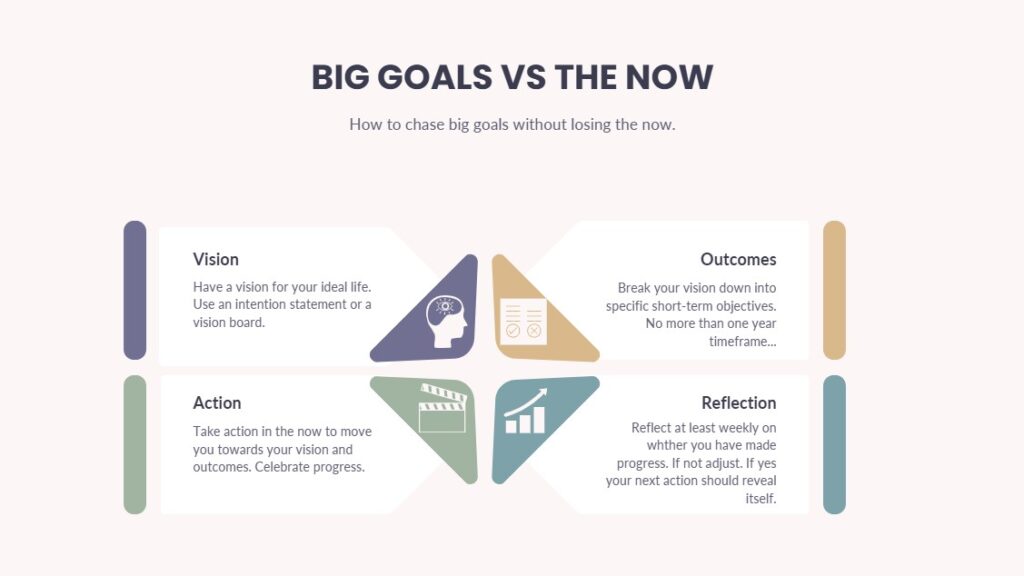
My solution combines the worlds of the future, past and present. It follows a pattern of vision – objective – action – reflection.
Vision
A vision is a future view of your ideal life. It can be vague and unspecific or focussed and specific. It can also involve all areas of your life or just one narrow band of existence. The beauty of a vision is that it can change as you grow, but it is always on the horizon; you never actually arrive at your vision.
You can also drop things from your vision or add things to it. You can also review it as you go. There are many ways of formulating a vision but I like the Intention Statement. In my post Using an Intention Statement to Achieve Your Goals, I explain in more detail how this works and how to formulate one.
Other people prefer vision boards. Both work fine. The major benefit of a vision is that this is where you can add any shiny objects and those someday/maybe items. They are safely captured so you that nothing is lost. Later, you may remove any item that is not relevant or ‘shiny’ anymore.
Objectives
Next in the hierarchy comes objectives. Again, they are future based, but this time they are specific. They should also be shorter time scales, ideally around a month to a year. The important thing about objectives is that they are fixed. Once you set one, you should follow through until completion. Some examples of objectives are goals, campaigns, projects and new habits. How many objectives should you have at any one time? Ideally just the one, although you could manage up to three. I would say that any more than three is too much. You could mix and match your objectives with say: one annual goal, one new habit (90 days) and one month-long project. As you complete one objective, you can add one more. Be sure to celebrate your completion, though.
From objectives comes plans of action:
Action
Actions are living in the now. This is where life exists. You can’t do a project or a goal; you can only perform actions in the here-and-now that move you to your objectives. What you do now is the only thing that can help you. Actions can include what project managers call Business As Usual – this is everything you do now, either routinely or habitually. Then there are iterative actions, these are new tweaks to your business-as-usual such as: you add a small meditation session to your morning routine. Then, there are those actions that you have planned that move you to an objective.
Reflection
Finally, there is reflection, this is when you allow yourself to delve into the past, both recent and distant. It is where you analyse what’s happened. It could include just your memories of events or it can be analysing data. The important thing is you are looking into the past to see what went well and what could be improved. I use a PIG analysis grid to do this. Check out my post Skills and Mastery, where I show you how to do a PIG review.
Putting it together
Here’s an example of this framework in action. You might have a vision of financial independence and everything that that entails, around your lifestyle. An objective might be to buy your first rental property this year, which has a certain value of cashflow. This would be specific enough although you can get as specific as you want. Next, would be an action, such as to research online to find a mentor who has done this before.
To reflect at your Weekly Review, you could ask yourself if you have found one or not. If not, what could you do differently next week? A new action could be to research property clubs in your local area. At your reflection stage you analyse whether you have moved forward in your vision or not. If you have, then the next action step will reveal itself. You don’t need to plan all the way to the end, just take one action step at a time.
Summary
Give yourself a break. Enjoy small progress. The destination is just one small part of life, most of our life is the journey.
In the end, the game isn’t about choosing between the future you want and the moment you’re standing in. It’s about learning to let them work together. When you hold a vision lightly, set clear objectives, act with intention today and take the time to reflect, you build momentum without burning out or drifting aimlessly. Progress becomes a rhythm instead of a battle. If you stay patient, stay curious and keep showing up for the small steps, you’ll look back one day and realise you didn’t just reach a goal, you built a life that feels right both now and in the future.