


I’ve been passionate about personal development for a long time now. Once you get that first rush of ‘Yes I can achieve anything I set my mind to,’ you often overload yourself with goals, projects and things to do. Pretty soon you then realise that to really achieve anything worthwhile you need to focus.
So, I went from trying to do too many things at once, to focusing on one thing at a time but with having a list of the things to do after. This sometimes gave me the urge to rush through the thing I was focusing on, to get to the next thing as quickly as possible. The goal became, not what I was focussing on, but finishing my list.
Do you have the same urge to rush through your list. This is borne from a limiting belief and here I explore what that limiting belief could be and how you can change it for good.
“We have all the time in the world” – Louis Armstrong
Possible limiting beliefs behind the urge to rush
Your limiting belief could come from many different places and is usually created in childhood. Limiting beliefs run on autopilot under the surface of your consciousness. That means that you are not aware of them. They are like old computer programs that have served their purpose, but now you are older, they act as a handbrake on your progress.
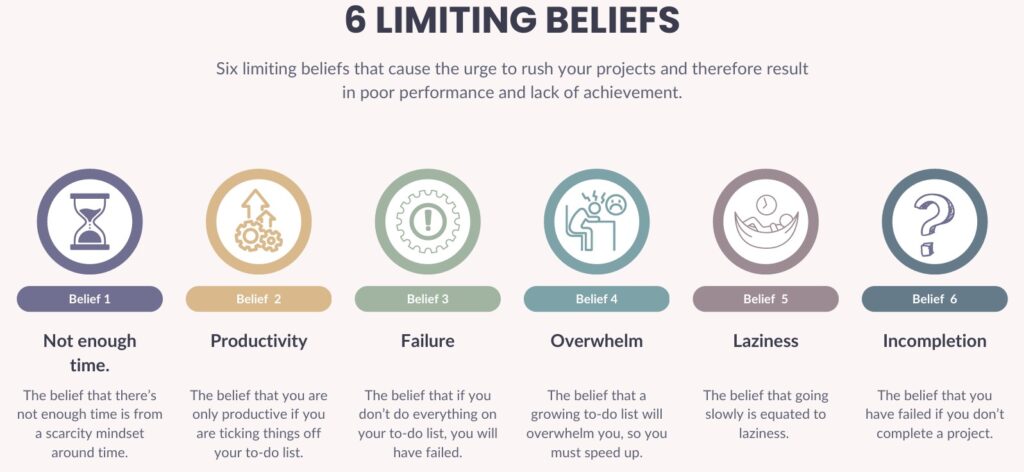
1. “I don’t have enough time.”
This is from a scarcity mindset around time. It can make you feel pressured to “get stuff done quickly” instead of deeply. The root about this is the fear of falling behind or wasting time. If you feel there is not enough time to get things done, you will naturally want to rush things. You may have a fear that life, business or opportunities won’t wait for you so you must rush.
2. “I’m only productive if I’m ticking things off.”
This mindset equates progress with the quantity of tasks done rather than quality or depth of work. You need visible output to validate your effort. For example, this can manifest in sales. You made 20 sales calls this week, but with not much to show for your efforts. Contrast this with spending more quality time with each customer, establishing deep rapport, understanding their business and discovering their motives. You make less calls but will sell more. Sometimes its more than a numbers game.
3. “If I don’t do it all, I’ll fail.”
This is a belief that success requires tackling everything on the list quickly, rather than letting momentum and consistency compound over time. This is related to the last belief in that you must do more. This time however, even if you have one to-do remaining on your list – you’ve failed. This is all-or-nothing thinking.
4. “The list will overwhelm me if I don’t get through it.”
Are you feeling unsafe with “unfinished” items on your list? Your list is growing because you aren’t finishing the tasks you’ve started. Your brain will see this as a threat and push you to clear them fast. Deep down you don’t trust your own system to capture and revisit open tasks. If you have a working system that captures inputs, to be processed later, you should be able to concentrate on the task at hand.
If you want a system you can trust I can recommend the Getting Things Done by David Allen. Check out my post where I give you an overview of the system.
5. “Slow equals lazy or falling behind.”
This could be a belief that first arose in childhood. School work was always under the clock. Bells ring to signify the end of the lesson and exams had to be done in the time allotted. Even today we have the hustle-culture which equates speed with worthiness. We frown upon slowness and taking your time. We want it and we want it now.
6. “Unfinished equals failure.”
You might believe that something only has value if it’s fully done, instead of seeing progress as valuable. Yes, projects need to be finished, but progress to a worthy long-term vision is valuable. So, you haven’t reached your target weight, but you are healthier and have more energy as you are changing your habits.
The Reframe – how to stop the urge to rush
Our minds are plastic. We can change beliefs once we have identified them. Below are 5 reframes that oppose the limiting beliefs above.
1. Time is abundant
When you focus on the right next thing, it doesn’t matter if you have a pile of things on your list. Time will pass anyway, you might as well spend it doing the right thing.
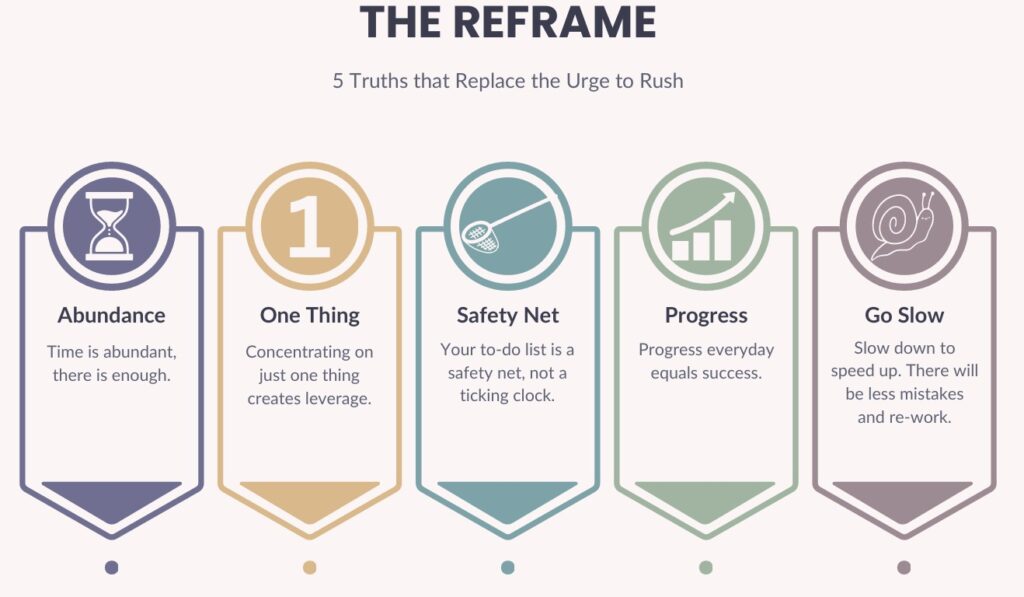
2. The one thing
Doing one thing, deeply, often creates more leverage than doing five things rushed. Pick any goal you can think of and there will be several habits and projects you can start that will help you achieve it. However, there will be one thing that if you do consistently and deeply, will enable you to reach your goal more effectively.
I had noticed with disappointment that my weight had crept up to 20 pounds over my desired weight. It happened gradually over a period of years. I decided to do something about it, so I made a list of things I could do – calorie counting, 10,000 steps per day, lifting weights, cutting out junk food and alcohol, smaller portions and many more things. I tried all of them and the weight stubbornly stayed.
Then I discovered the 16:8 fast, where you eat food in an 8-hour window and fast for the remaining 16 hours. You can drink zero calorie drinks during the fast, like black coffee or water, but any drinks with calories weren’t allowed. In effect, all this meant for me was making sure I ate my first meal of the day, 16 hours after the last meal or drink the day before. The important thing is I didn’t change anything else; this was all I did, and the 20 pounds dropped off within 5 months.
3. Your to-do list is a safety net, not a ticking clock.
Writing down your things to do in a trusted system, means you can let it go, until its time is due. Trust that whatever you captured is there waiting, you won’t lose it. This list of captured ideas and things you might do is not your to-do list. It’s a list of things you might do someday.
4. Progress Equals Success
When you change your mindset away from completion-equals-success, to progress-is-success, this frees you up to focus on the one thing. You don’t need to complete every job in one sitting. Forward motion compounds over time.
5. Slow down to speed up
Time expands when you slow down and focus. Rushed tasks usually need to be corrected or reworked, therefore taking more time than it should do. Calm focus saves time in the long run.
Practical steps to help you focus
When changing limiting beliefs, often we have years of programming to undo. Repetition is therefore the key. Here are some affirmations and a visualisation you can use, which will help install new beliefs. Repeat them, until they feel normal, boring or stale. That means that your unconscious has accepted them. This combination works because, the affirmations calm your nervous system (“I have time, I am safe”). Also, the visualisation retrains your brain to see focus as completion, even if the larger list remains.
Mantra / Affirmation Sequence
When the urge to “rush” feeling comes up, pause and say to yourself:
“This work will get done in the right time. My only job is to give today’s piece my full focus.”
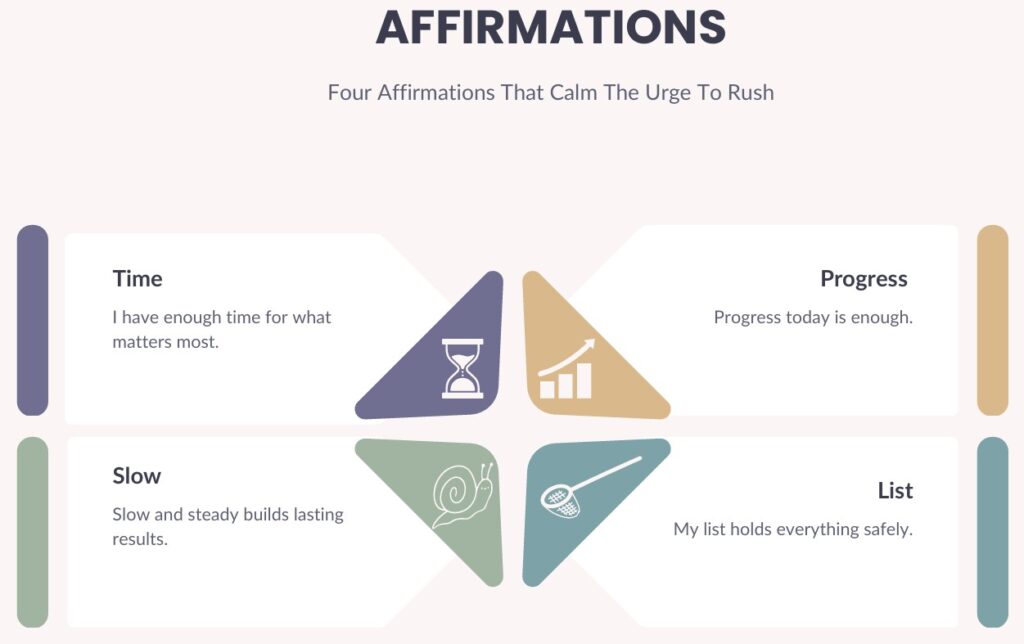
Here are some affirmations you can read aloud or in your head. Repeat these 3 times per day, slowly, breathing as you do it:
- “I have time for what matters most.”
- “Progress today is enough. Completion will come in its own time.”
- “My list holds everything safely. I only need to carry one thing at a time.”
- “Slow and steady builds lasting results.”
Visualisation Scenario
Here’s a short visualisation you can run in a couple of minutes.
First imagine your task as a single stone in front of you. It’s smooth, solid and manageable. Your job is simply to polish this stone, not the whole mountain.
Behind you, see a basket filled with other stones. That’s your list. They are safely stored, waiting their turn. Nothing will disappear.

Now picture yourself calmly polishing the single stone. You don’t rush; you’re steady. As you focus, the stone shines.
Finally, imagine placing the polished stone gently into an empty basket in front of you. One by one, you will take each stone and polish it. They will take their place among the others and the basket will fill with polished, shining stones.
Conclusion
Quieten the urge to rush. If something is worth doing, it is worth doing well. You can only do things well when you give them your full attention. Slow down and take your time, you have all the time in the world.